
Embryo freezing after IVF (In Vitro Fertilization)
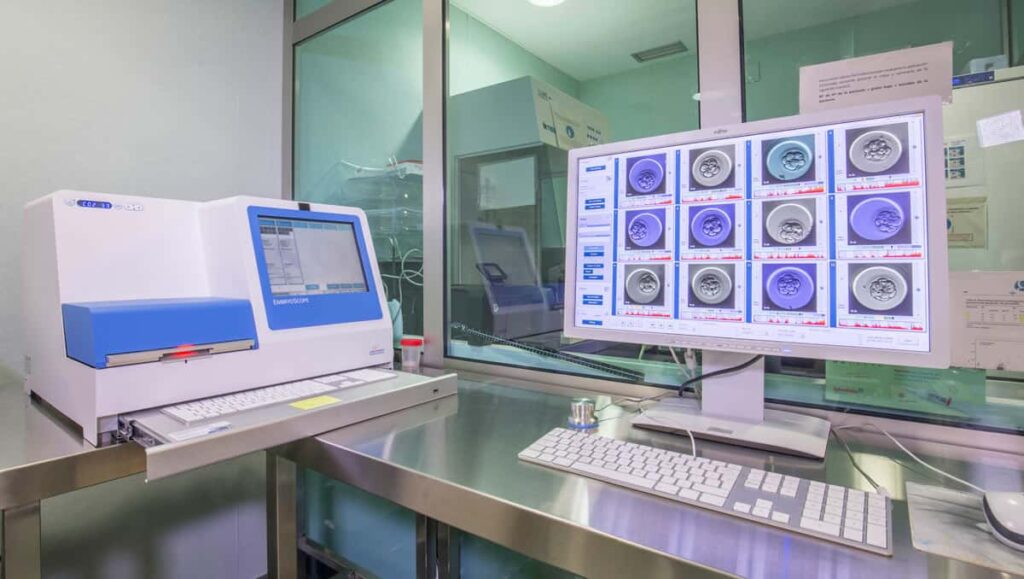
When we prescribe IVF (in vitro fertilization), a procedure that is complex, expensive, and not without risks, we must try to make it as efficient as possible without increasing the risk of complications for the patient. To achieve this, we stimulate the ovaries with the goal of obtaining several oocytes, since not all will be mature, not all will be fertilized, and not all will be of sufficient quality for transfer and have good pregnancy prospects.
In this process, the goal is to have one or two good-quality embryos for transfer. However, sometimes the procedure is more efficient, and we obtain more good-quality embryos than necessary for transfer: in these cases, we resort to freezing them using the vitrification technique.
These frozen embryos will be used for a new attempt if pregnancy is not achieved, or to seek a new pregnancy. Current law also provides for the donation of these embryos to other couples or for research, or even their destruction, depending on the individual patient’s situation. We will explain this later.
What is the vitrification technique?
Embryo vitrification marked a turning point in reproductive medicine, as it significantly increased the survival rate of embryos after thawing.
This technique, unlike slow freezing, is an ultra-rapid freezing, which involves subjecting embryos to a sudden change in temperature within a few seconds. It wasn’t until 2003 that it was approved by the American Society for Reproductive Medicine (ASRM), and in 2005-2006 we began using it in assisted reproduction clinics in Spain.
It involves subjecting embryos to a sudden drop in temperature, specifically to -196°C in a liquid nitrogen tank. This high freezing speed, along with the use of high concentrations of cryoprotectants, prevents the formation of ice crystals and thus prevents damage to cellular structures.
Embryo vitrification, also known as embryo cryopreservation, is currently a successful technique with a very good prognosis, given the high embryo survival rate (around 98% compared to 50% with slow thawing) and the high pregnancy rate of patients who have had the opportunity to freeze embryos.
However, freezing is not always possible: we can do so in approximately 40-50% of IVF treatments, and in between 80 and 90% of treatments with donated oocytes or egg donation, when there are good-quality surplus embryos.
Data from the URE Gutenberg Center
Our experience is as follows: 85% of patients who have been able to freeze embryos achieve pregnancy, either during the initial IVF treatment (with fresh embryos) or by thawing frozen embryos. To obtain this data, we analyzed 1,900 treatments, which means we were able to congratulate 1,615 patients on achieving the desired pregnancy.
Embryo cryopreservation is a fundamental tool that benefits not only couples who have been unable to achieve pregnancy with fresh IVF treatment, but also those who, after achieving pregnancy, desire a second pregnancy. It can also be used in cases where, for medical reasons, we advise against fresh embryo transfer (for example, risk of ovarian hyperstimulation, endometrial deficiency, etc.). In these cases, we can defer the transfer of frozen embryos, which remain vitrified in our bank until the medical reason that prevented their transfer disappears.
What happens if I no longer need the frozen embryos?
In addition to the use of embryos by the woman or couple herself for second or subsequent pregnancy attempts, the Assisted Reproduction Law contemplates other uses. These are:
- Donation for reproductive purposes to other couples, always guaranteeing confidentiality and anonymity.
- Donation for research purposes. This option always requires the express consent of the couple or, where appropriate, of the woman responsible for the embryo for its use in the specific research project, after detailed information and understanding of the purposes of the research, its phases and timeframes, specification of its restriction to the basic setting or its extension to the clinical setting, as well as its possible consequences.
- Cessation of its storage without further use. This last option requires, in addition to the approval of the center’s medical director, a favorable opinion from independent specialists outside the corresponding center, indicating that the recipient does not meet the clinically appropriate requirements for the practice of assisted reproduction techniques.
It is important to emphasize that each couple is responsible for their embryos, and that the goal of treatment should not be to have embryos to freeze, but rather to pursue purely reproductive purposes.
For this reason, all assisted reproduction centers that have embryo storage banks are required to request from the woman or couple, at least every two years, the renewal or modification of the consent for the use of the embryos. If it is impossible to obtain the corresponding consent signature during two consecutive renewals, the embryos will remain at our center’s disposal, and we may use them for any of the aforementioned purposes, maintaining the established requirements of confidentiality and anonymity, and maintaining the free and non-profit nature of the process.
At the URE Centro Gutenberg, we have extensive experience with this technique, and we strive every day to continuously research and improve this procedure. Thanks to this, we already have an embryo survival rate close to 100% and a pregnancy rate that, in many cases, begins to exceed the pregnancy rate of the treatment itself.
Are you thinking about undergoing in vitro fertilization treatment? Contact us! Our fertility specialists will be happy to help you. You can make an appointment here.