
Forty years are nothing…
The Birth of Louise Brown: A Milestone in Assisted Reproduction
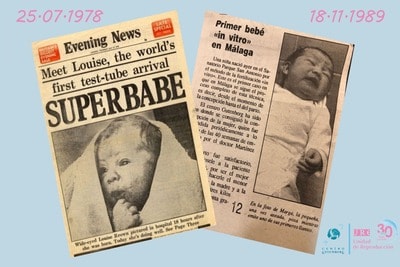
On July 25, 1978, in a small town in northern England, Louise Brown was born. It wouldn’t have made headlines… if it weren’t for how she was conceived. After numerous attempts, tremendous effort, and sacrifice from the medical team of Robert Edwards and Patrick Steptoe, Louise became the first child in the world born through in vitro fertilization (IVF). This groundbreaking moment opened new doors to the hope of parenthood, now reaching millions of families who have fulfilled their dreams through assisted reproductive technology. For many, it also marked the beginning of a complex emotional journey, often filled with emotions fertility problems bring to light.
But the journey was far from easy. Beyond the tireless work and scientific breakthrough achieved by Edwards and Steptoe, they — along with many pioneers in reproductive medicine around the world — had to face a skeptical and often judgmental society. A world largely unprepared for the paradigm shift that Louise’s birth would bring.
The History and Evolution of Assisted Reproduction
On July 25, 1978, in a small town in northern England, Louise Brown was born. This would not have been newsworthy… if not for how she was conceived. After numerous attempts, tireless effort, and the dedication of the medical team led by Robert Edwards and Patrick Steptoe, Louise became the first child in the world born through in vitro fertilization (IVF). This groundbreaking event opened new doors to the dream of parenthood for millions of families who have since achieved it thanks to assisted reproduction techniques.
But the path was not easy. Beyond the scientific achievement of Edwards and Steptoe, they and many of the pioneers in reproductive medicine worldwide had to face a critical and often inquisitive society, unprepared for the changes the birth of Louise represented.
Assisted Reproduction in Spain
Six years later, on July 12, 1984, Victoria Anna was born: the first baby in Spain — and sixth in the world — conceived via this technique. This success was due to the efforts of the medical team led by Anna Veiga and Pedro Barri.
Five years after that milestone, and eleven years after Louise’s birth, the Reproduction Unit at Centro Gutenberg witnessed its own miracle. Thanks to the efforts of our founder Dr. Manuel Martínez Moya and embryologist Carmen Segura, Lorena was born in 1989. She was our first successful IVF birth, the first in the province of Málaga, and the third in Andalusia.
Behind each of these miracles is always a woman or a couple — future mothers and fathers — with a persistent dream. They are full of hope, blind faith, and trust in the medical team dedicated to fulfilling their greatest wish: to welcome their baby.
By 2018, when Louise turned forty, we had witnessed countless changes and ongoing evolution in assisted reproduction treatments. More than eight million children worldwide have now been born thanks to IVF. In Europe, Spain leads in the number of births, according to data presented at the annual meeting of the European Society of Human Reproduction and Embryology (ESHRE). In 2015 alone, 3.8% of newborns in Spain were born through IVF (SEF Registry 2015). That’s 15,992 babies — a number that continues to grow each year.
Advances in Assisted Reproduction and Fertility Treatments
The past four decades have brought major advancements in assisted reproduction. Constant evolution has led to better outcomes and fewer complications. Some examples include:
- Development of improved medications for ovarian stimulation, vital for increasing treatment efficiency.
- Laboratory advances such as intracytoplasmic sperm injection (ICSI), a solution for severe male infertility issues.
- Enhanced embryo culture conditions, allowing better embryo development and observation through techniques like time-lapse monitoring.
- Vitrification, a freezing method that increased egg and embryo survival rates from under 50% to over 90% after thawing. This innovation enabled fertility preservation for both medical and social reasons.
- Preimplantation genetic diagnosis (PGD), which has improved outcomes for couples with recurrent miscarriage, women over 38, and those carrying monogenic recessive diseases. With PGD and genetic compatibility testing, many severe genetic diseases in offspring can now be prevented.
These and many other advancements in assisted reproduction have resulted in higher live birth rates and safer treatments. For instance, transferring a single embryo is now the standard, reducing the risk of multiple pregnancies without compromising pregnancy rates. Today, a successful and healthy pregnancy is more likely than ever — with success rates now exceeding 90% in many cases, a significant leap from the rare successes of four decades ago.