
When to freeze embryos after an in vitro fertilisation (IVF) cycle
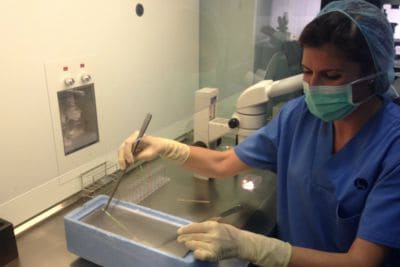
Our experience at URE Centro Gutenberg tells us that we can freeze surplus embryos in between 20 and 30% of IVF treatments with own oocytes, and in between 40 and 50% of treatments with donated oocytes. In addition, between 5 and 10% of cycles require the embryos to be frozen, as for various reasons it is better to transfer them in a later cycle.
When freeze embryos after an in vitro fertilisation?
At the Gutenberg Reproduction Unit, we freeze embryos using vitrification, an effective and safe procedure that currently has embryo survival rates after thawing of over 75%. Given this high survival rate, the possibility of freezing embryos greatly increases the effectiveness of an in vitro fertilisation cycle.
Thanks to this, many women can fulfil their desire to have children and have more than one child by undergoing a single IVF treatment. In addition, at the URE, most cryotransfer cycles are performed during a woman’s natural cycle. This means that, generally, very little medication is administered, so the procedure is very simple and does not require much effort on the part of the woman.
What is the process of In Vitro Fertilisation treatment like?
In In Vitro Fertilisation treatment, once the oocytes have been extracted and brought into contact with the sperm, fertilisation normally occurs. During the three days following fertilisation, the embryos divide into cells of the same size, which are distributed evenly throughout the embryo in the form of a ‘mulberry’. At this point, we say that the embryo is in the cell stage.
From the fourth day onwards, in most embryos that have developed correctly, a series of events occur, which are evident in a total change in the structure of the embryo: the blastocyst is formed, the stage prior to implantation. In culture, this stage should be reached between five and six days after fertilisation, and approximately 60% of good quality embryos achieve this.
Once the embryos have been obtained in culture and depending on each case, in most treatments it is possible to choose the stage of development at which the embryos are transferred to the woman’s uterus or frozen for later treatment. Embryos can be used at any stage of their development, with the most commonly chosen stages being the cell stage (day 2 or 3 of embryonic development) and the blastocyst stage.
How to select the timing of embryo transfer or freezing in IVF
The choice of when to transfer and/or freeze embryos from an in vitro fertilisation cycle depends on many factors, related both to the number and quality of the embryos and to the couple’s medical and reproductive history. Keeping the embryos in culture for more days, although it is not yet clear that this increases the chances of pregnancy, is in many cases advisable both for selecting those to be transferred and for choosing those to be frozen with the best chances of success. It all depends on the individual case of each woman or couple.
As for when we freeze the embryos, this is: day +2 or +3 from fertilisation, cell stage, or day +5 or +6 in the blastocyst stage. Based on our experience at URE Centro Gutenberg, we can say that a much higher number of embryos are frozen at the cell stage than at the blastocyst stage. In addition, the pregnancy and implantation rate of blastocysts is slightly higher, while their survival rate is slightly lower than that of embryos frozen at the cell stage.
Be that as it may, each case is different and there is no fixed pattern to follow. At the Centro Gutenberg Reproduction Unit, we choose the most suitable time for each particular treatment, always with the aim of obtaining the best final results. In this way, in recent years we have maintained pregnancy rates with frozen embryos of between 50 and 68% with egg donation and our own eggs.
At the URE, we have great confidence in cryotransfer techniques, and we strive to continuously research and improve this procedure. As a result, we now have an embryo survival rate of close to 100% and a pregnancy rate that, in many cases, is beginning to exceed the pregnancy rate of the treatment itself.