
What Is a Sperm Bank and How Does It Work?
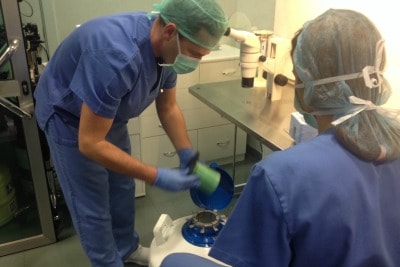
A sperm bank is a facility where frozen semen samples are stored for later use in assisted reproduction techniques, such as artificial insemination or in vitro fertilization (IVF). Think of it as a sealed tank—similar in design to a thermos—capable of maintaining extremely low temperatures. Samples are stored in liquid nitrogen or nitrogen vapor at about -196°C.
Today, most authorized fertility clinics, including URE Centro Gutenberg, have sperm banks to store samples from patients and/or donors. Some sperm banks also exist solely to supply donor sperm to other fertility centers.
How Are Samples Stored in a Sperm Bank?
To store a semen sample in a sperm bank, it must first be frozen using a controlled, step-by-step cooling process until it reaches liquid nitrogen temperatures. Before freezing, special substances called cryoprotectants are added to protect sperm cells from cold-related damage. These protectants allow the sperm to regain activity after thawing.
Frozen samples are placed in small labeled containers known as straws and stored in the sperm bank. Often, multiple samples need to be frozen, as not all sperm will survive the freeze-thaw cycle.
Why Are Semen Samples Frozen and Stored?
When fertility specialists recommend freezing semen, the main goal is usually to preserve fertility that may be at risk. Remarkably, the quality of frozen sperm does not degrade over time—once frozen, the sperm remains viable indefinitely.
There are several key reasons why a patient might need to freeze and store sperm in a bank:
- Medical treatments or illnesses that may impair sperm production, such as testicular cancer or cancer treatments like chemotherapy or radiotherapy.
- Poor semen quality that could worsen over time.
- Vasectomy, a voluntary male sterilization procedure. Before undergoing a vasectomy, freezing one or more semen samples is recommended to avoid needing another surgical procedure (such as vasovasostomy or testicular biopsy) if future reproduction is desired.
What Is a Donor Sperm Bank?
As mentioned earlier, another purpose of sperm banks is to store frozen samples from anonymous donors with varied phenotypic characteristics—such as hair color, eye color, height, blood type, and more.
All sperm donors must pass rigorous screening and testing before their samples can be used in assisted reproduction. This process is strictly regulated by current legislation: Law 14/2006.
Donor sperm is used in fertility treatments for:
- Women whose partners produce no sperm
- Single women who wish to become mothers
- Same-sex female couples
The most common techniques used are artificial insemination and IVF, depending on the individual case.
How Are Sperm Banks Managed and Maintained?
This is a critical part of ensuring the safety and integrity of the samples. The staff in charge closely monitors the liquid nitrogen levels to maintain proper storage conditions at all times.
All frozen samples are logged in secure, confidential databases, and their identification and location are carefully managed to guarantee full privacy and traceability.
URE Centro Gutenberg has operated a sperm bank since 1987, and we have extensive experience in sperm storage and management—thanks to our team of continually trained specialists.
If you’d like more information about how sperm banks work or about sperm donation, feel free to contact us anytime. Our fertility experts at URE Centro Gutenberg are here to guide and support you.