
How to Read Your Semen Analysis Results: Sperm Count, Motility and Morphology Explained

If you are trying to conceive or considering fertility treatment, you may have been asked to have a semen analysis. But what do the results actually mean? And can an abnormal semen analysis affect your chances of having a baby?
A semen analysis, also known as a sperm test or spermiogram, is one of the first tests used to assess male fertility. It provides valuable information about the number of sperm in a sample, how well they move and their shape, helping us identify possible factors that could make conception more difficult.
At URE Centro Gutenberg, our fertility clinic in Málaga, Spain, we use semen analysis results alongside the woman’s fertility assessment to recommend the most suitable approach for each couple. Depending on the findings, this may involve intrauterine insemination (IUI) or in vitro fertilisation (IVF).
If you live abroad, you can usually arrange a semen analysis in your home country and share the results with our medical team before travelling to Spain.
In this guide, we explain how to interpret the main parameters of a semen analysis, the latest World Health Organization (WHO) reference values and what happens if your results are outside the expected ranges.
What does a semen analysis measure?
A semen analysis examines both the physical characteristics of the semen and the sperm cells it contains.
The examination is divided into two main parts:
- Macroscopic examination: assesses semen volume, appearance, pH, liquefaction and viscosity.
- Microscopic examination: measures sperm concentration, motility, morphology and other characteristics relevant to male fertility.
If the results suggest a possible problem, additional tests may be recommended, depending on your medical history and individual circumstances.
It is important to understand that a semen analysis cannot determine on its own whether a man is fertile or infertile. Results must always be interpreted as part of a wider fertility assessment.
Macroscopic examination: Understanding your semen sample
The first stage of the analysis looks at the general characteristics of the semen.
Semen volume
Semen volume refers to the amount of fluid produced during ejaculation.
According to the WHO’s 2021 reference values, the lower reference limit is 1.4 ml.
A lower volume may be related to different factors, including incomplete sample collection, problems affecting ejaculation or certain medical conditions.
Semen pH
The pH measures how acidic or alkaline the semen is.
Semen is normally slightly alkaline, with a pH generally around 7.2 or above.
An unusual result may provide additional information about the glands involved in semen production.
Liquefaction
Immediately after ejaculation, semen is usually relatively thick. It gradually becomes more liquid, allowing the sperm to move more freely.
This process normally takes place within approximately 60 minutes.
Appearance and viscosity
Semen typically has a fairly uniform, greyish-white appearance.
Viscosity refers to how easily the semen flows. Excessively thick semen or abnormal liquefaction may interfere with sperm movement and should be recorded in the laboratory report.
Microscopic examination: Sperm count, motility and morphology
This is one of the most important parts of the semen analysis, as it allows us to evaluate the characteristics of the sperm themselves.
Sperm concentration: How many sperm are present?
Sperm concentration measures the number of sperm cells in each millilitre of semen.
The WHO’s 2021 lower reference value is 16 million sperm per millilitre.
The laboratory also assesses the total number of sperm in the entire ejaculate, with a lower reference value of 39 million.
A result below these values does not automatically mean that natural conception is impossible. However, it may indicate that further investigation is needed.
Sperm motility: How well do sperm move?
For a sperm to fertilise an egg naturally, it needs to travel through the female reproductive tract.
This is why sperm motility is particularly important.
There are three main categories:
- Progressive motility: sperm that move forwards effectively.
- Non-progressive motility: sperm that move but do not make effective forward progress.
- Immotile sperm: sperm that show no movement.
According to the WHO’s 2021 reference values:
- Progressive motility: 30%
- Total motility: 42%
Reduced sperm motility may make natural conception more difficult, although its significance depends on the complete semen analysis and other fertility factors.
Sperm morphology: Does sperm shape matter?
Sperm morphology describes the shape and structure of sperm cells, including the head, midpiece and tail.
The WHO’s lower reference value for normal sperm morphology is 4%.
This figure can sometimes cause unnecessary concern. It does not mean that the remaining sperm are necessarily incapable of fertilising an egg.
Sperm morphology is just one element of the overall assessment and should never be considered in isolation.
Sperm vitality
Vitality measures the percentage of living sperm in the sample.
The WHO’s 2021 lower reference value is 54%.
This test can be particularly useful when sperm motility is very low because a sperm cell that is not moving is not necessarily dead.
Other cells and sperm agglutination
The laboratory may also identify white blood cells, red blood cells or sperm cells that stick together.
These findings can sometimes suggest inflammation, infection or other conditions, but additional investigations may be necessary to establish their significance.
What are normal semen analysis results? WHO 2021 reference values
The following table summarises the main lower reference limits established by the World Health Organization.
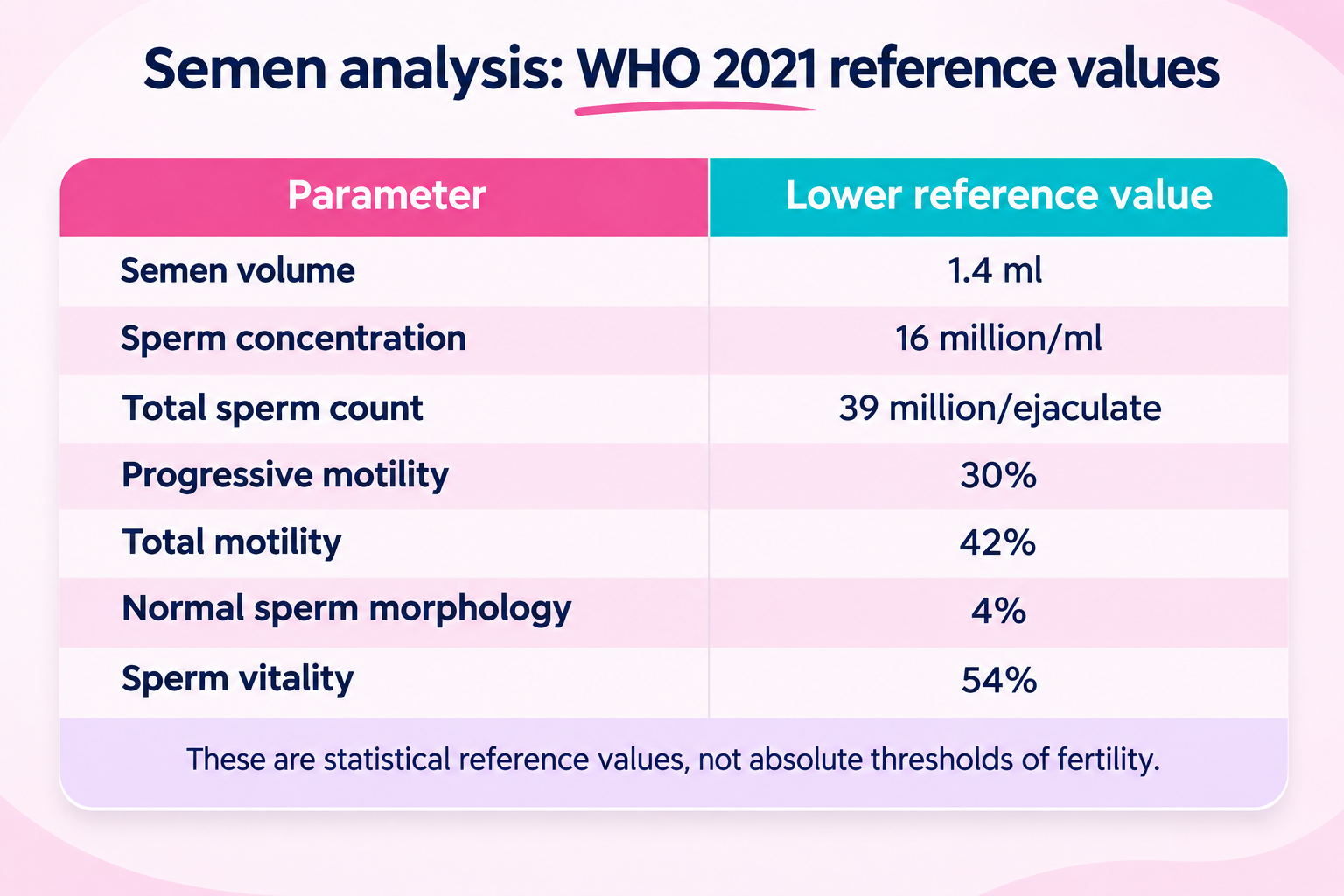
Important: These figures are reference values, not absolute thresholds separating fertile and infertile men. A result outside these ranges does not necessarily mean that pregnancy is impossible.
What does an abnormal semen analysis mean?
If your semen analysis report includes unfamiliar medical terms, understanding them can help you have a more informed discussion with your fertility specialist.
Here are some of the most common:
- Hypospermia: lower-than-expected semen volume.
- Oligozoospermia: reduced sperm concentration.
- Cryptozoospermia: an extremely low number of sperm, sometimes only detected after the sample has been concentrated.
- Azoospermia: no sperm are detected in the ejaculate after appropriate laboratory examination.
- Asthenozoospermia: reduced sperm motility.
- Teratozoospermia: a percentage of normally shaped sperm below the reference value.
- Necrozoospermia: an abnormally high proportion of dead sperm.
Sometimes, several abnormalities are found in the same sample.
Does an abnormal sperm test mean I cannot have children?
Not necessarily.
Semen parameters can vary between samples. Factors such as recent illness, fever, lifestyle habits or difficulties collecting the sample may affect the results.
Depending on the findings, your specialist may recommend repeating the analysis or carrying out further investigations.
In some circumstances, tests such as sperm DNA fragmentation analysis may also be considered.
The most important thing is to understand why the results may be altered and which options are available in your particular situation.
IUI or IVF with ICSI: How does sperm quality influence treatment?
Semen analysis results play an important role in deciding which fertility treatment may offer the most appropriate option.
However, the decision also depends on other factors, including the woman’s age, ovarian reserve, fallopian tube health and previous reproductive history.
When might intrauterine insemination (IUI) be suitable?
Intrauterine insemination may be recommended when sperm quality is adequate and there are enough motile sperm after laboratory preparation.
The procedure involves placing a prepared sperm sample directly into the uterus around the time of ovulation.
It is generally a less invasive treatment than IVF, but it is not suitable for every fertility problem.
When might IVF with ICSI be recommended?
When sperm concentration or motility is significantly reduced, In Vitro Fertilisation (IVF) may be a more suitable option.
One technique commonly used in IVF is ICSI (intracytoplasmic sperm injection), which involves injecting a single sperm directly into an egg.
This technique can be particularly helpful in certain cases of male factor infertility.
At URE Centro Gutenberg, our fertility specialists and embryology team work together to assess the most appropriate treatment for each patient.
You can learn more in our articles on the differences between artificial insemination and IVF in Spain.
Can you improve sperm quality?
In some cases, lifestyle changes may help support sperm health.
Maintaining a balanced diet, exercising regularly, avoiding smoking, limiting alcohol consumption and maintaining a healthy weight are all sensible measures.
However, not all sperm abnormalities can be improved through lifestyle changes alone.
If your semen analysis shows significant alterations, a medical assessment is important to identify possible underlying causes.
For more information, read our guide to male infertility, its causes and treatment options.
Can I have a semen analysis in my home country before starting IVF in Spain?
Yes. If you are considering fertility treatment abroad, you can usually have your semen analysis performed in your home country before travelling to Málaga.
At URE Centro Gutenberg, we regularly assist international patients who wish to organise the initial stages of their fertility assessment remotely.
You can share your existing test results with our medical team, who will review them alongside your medical history and any previous treatments.
If additional investigations or a repeat semen analysis are needed, we will explain the next steps and whether they can be arranged locally or at our clinic.
This allows us to start assessing your situation before you travel and helps you plan your fertility treatment in Spain with greater confidence.
Find out more in our guide on how to plan IVF treatment from abroad.
Worried about your semen analysis results? We are here to help
Receiving an unexpected result can be worrying, especially when you are hoping to start a family.
But an abnormal semen analysis does not necessarily mean you cannot become a father. Today, assisted reproduction offers different possibilities for many forms of male infertility.
At URE Centro Gutenberg, the first fertility clinic in Málaga, established in 1987, we combine extensive reproductive medicine experience with personalised care and our own IVF laboratory.
Our international team supports patients from different countries, helping them understand their results, explore their treatment options and organise their journey to Spain.
You can begin with a free online medical consultation, without travelling to Málaga.
Our specialists will review your circumstances, answer your questions and help you understand the next steps.
Request your free online consultation
Your dream, our mission. Your happiness, our commitment.